What Better Supply Is Actually Worth Against the Open Exchange
Curation may be an overused buzzword, but managing programmatic inventory against the open exchange drives real value for advertisers.


THE CHALLENGE
The publisher had scale, strong content, and no shortage of advertising partners. It also had a familiar problem: programmatic revenue had stopped growing with the audience.
Adding more SSPs was not fixing it. The same demand was reaching the same impression through multiple paths. Static floors treated high-value and average inventory too similarly. Slow bidders remained in the auction even when their incremental revenue contribution did not justify the latency they created.
On paper, the publisher had a competitive auction. In reality, it had a complicated one.
WHAT WE DID
Guidelight mapped every meaningful path into the auction by geography, device, format, demand source, bid density, win rate, timeout behavior, CPM and net revenue contribution. That allowed us to distinguish incremental demand from duplicated demand.
- Reduced low-value and redundant demand paths rather than adding more integrations.
- Tightened timeout logic and removed bidders whose latency cost exceeded their incremental value.
- Rebuilt pricing around actual auction behavior instead of broad static floors.
- Separated premium inventory into packages where direct buyer demand could command a premium.
- Measured changes on net revenue per thousand sessions and revenue per ad opportunity — not CPM alone.
PERFORMANCE
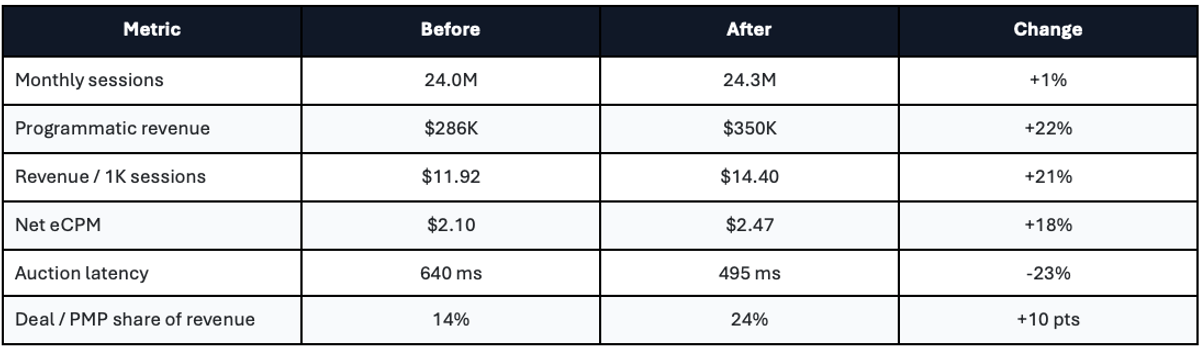
With traffic essentially unchanged, the modeled uplift represents roughly $64K in incremental monthly revenue — approximately $768K annualized — generated by making the existing inventory work harder.
THE TAKEAWAY
Publisher monetization is not won by connecting the most demand. It is won by creating the auction in which the right demand competes most efficiently for every impression.
The biggest revenue leak is often already inside the stack: redundant paths, poorly priced inventory, unnecessary latency and high-value impressions being treated like average ones.